visit ontolawgy™ LLC’s main site

2013-04-01

Connecting the dots: Political and legal visualizations from Federalists to metaphorical shoes

My company’s slogan, “connect . . . the . . . dots” is about using an ontology to connect loosely- or poorly-organized  “dots” of legal data to generate a picture of the law (hence the punny name).

This post discusses how people connect dots (sometimes literally) to paint pictures of the law or processes related to it to make complex data appear simple.

Moving from very general to extremely specific, first, there are two political visualizations. One is a chart of the political history of the U.S. Congress, followed by a dynamic visualization of U.S. Senate voting patterns over the past several years.

The next segment looks at ways to look at laws resulting from those politics with two different flow charts. One is a decision tree for evaluating hearsay exceptions, the other is a semantic directed graph that traces how to determine what kind of metaphorical shoes someone is wearing in a Medicare-related regulatory scheme. Yes, you read that correctly: There are actually Medicare regulations about not just one, but two different kinds of metaphorical shoes (details and links below).

Finally, there is a link to a survey about legal research systems. That might seem out of place at first, but one idea behind the survey is to figure out what people want to do with certain kinds legal data, specifically, how they can access the data in a way that allows them to better draw a mental or literal picture of the law, like the charts shown here. If there are enough responses to likely support statistical significance, there is a plan to publish the survey results. So, if this is something that interests you or your colleagues, please participate in the survey and ask your friends and colleagues to participate too.

Without further ado, on to the pictures.

Politics

If there was every any doubt that politics are the lifeblood of our representative democracy (or the atherosclerotic plaque slowing it to a halt), this vascular-looking chart should dispell those doubts. The picture itself describes this in more detail, but each color and the width of each color band show how many members of Congress in major parties fell/fall within certain zones of the political spectrum. At a glance, you can see the political effects (or sometimes causes) of external events. What is particularly striking to me is how the political climate seems to generally correlate to events such as economic downturns (Democrats gain seats) or wars (Republicans gain seats), or when you have both a war and an economic downturn (both parties tend to get more extreme). 
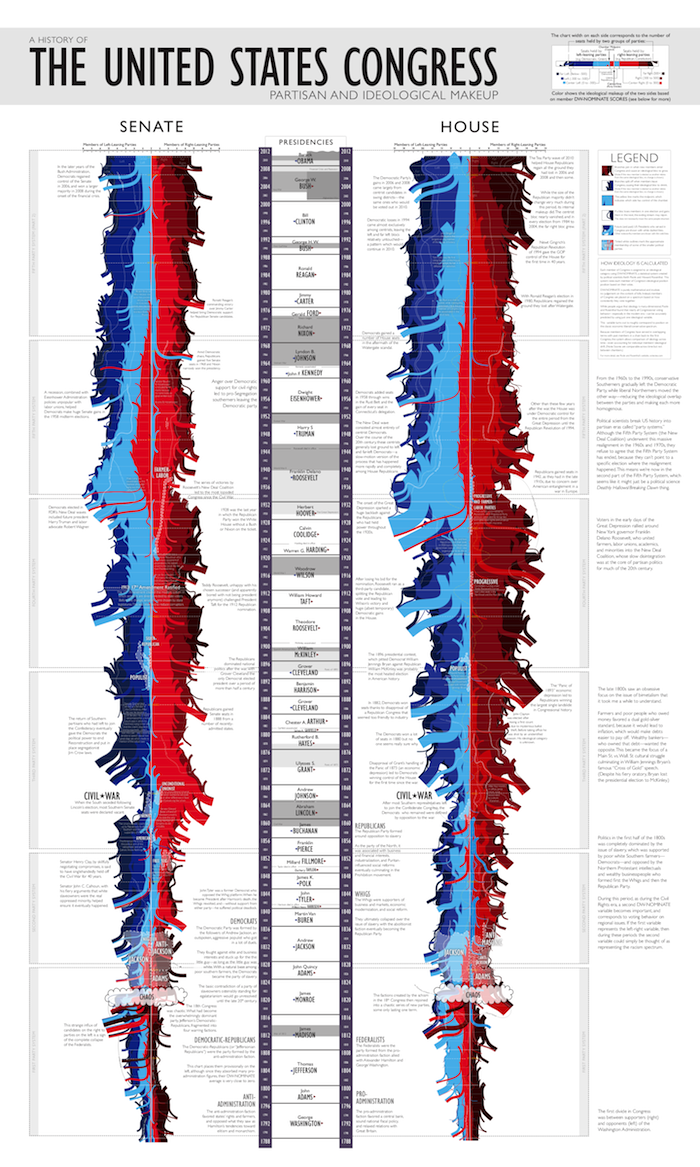

(Click here to see the chart at xkcd.com; once there, click on it for a full-size picture--it's huge and requires a lot of scrolling, but it’s worth it.)

Another fun political visualization is from Chris Wilson at Yahoo, (via Rob Richards; Thanks, Rob!) which looks at voting networks in the U.S. Senate.

As an aside, for people who are interested in how technology can help make law more accessible and understandable and don’t follow Rob on Twitter or Google Plus (or both), you are missing out in a big way. Rob curates a steady and consistently excellent stream of journal articles, blog posts, and news stories about these issues. I don’t know how he does it, but I’m grateful that he does, and I’m certainly not alone.

That said, here’s the visualization (if you can’t see it here, please go to the original site):


There are so many ways to look at it, but I think it’s interesting to move the slider all the way to 100% to see what happens; to horrendously mix metaphors, this helps you see who really circles the wagons and who are the cats that need to be herded.  Depending on your politics, you can draw all kinds of inferences from this, but the main point is that the data are there (thanks to GovTrack.us) and presented in a valuable way that allows people to quickly see what they’re looking at.

Moving on, let’s look at the results of politics: Laws. They’re written in words, but the words are not necessarily clear or written in a way designed to promote efficiently analyzing them, so pictures can help.

Law: Hearsay and Metaphorical Shoes

Hearsay 

One way to make sense of legal requirements is a flow chart, that is, a map of facts, decision points, and results. This is a flowchart of hearsay exceptions by Margaret Hagan, currently a law student, who posits: “My hypothesis: the act of putting together a flowchart is itself one of the best ways to learn an area of law... it takes lots of flipping through pages, tracing through notes, going the rule book, and checking whether what you remember or guess is in fact true. It also forces you to go step by step through the logic of a law in a situation.” (again, thanks to Rob Richards for pointing out her work):
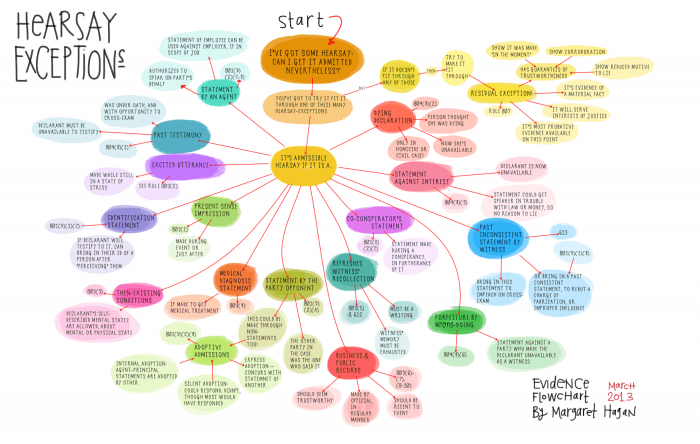


(See http://www.openlawlab.com/2013/03/20/law-flowcharts-hearsay-exceptions/ for original)

I could not agree more, and for years I have made flow charts when looking at an area of the law that is new to me. But it is a laborious process, which is what led me to look for a way to do it more efficiently.

Metaphorical Shoes

Because the laws Congress enacts are often so complex, many of them essentially tell the Executive Branch to figure out how to implement them by writing regulations, which brings us to this abbreviated look at metaphorical “shoes” (click to enlarge):


This is a semantic directed graph (output from a query to one of my company’s systems) for a narrow slice of the “Stark Law” regulations. Similar underlying data can also be used to map processes like a more traditional flow chart. A quick (overly-general) primer on the Stark Law and related regulations: They impose severe financial penalties on physicians reimbursed by U.S. Medicare for referring patients to entities in which the physicians have a financial interest. The main job for lawyers is to figure out whether a doctor has a financial interest (as defined—or not—in the law) in an entity to which the doctor refers patients.

The chart shows a simplified subset of selected relationships among grammatical variations and contextual uses of a metaphorical phrase “stands in the shoes” vs. “stand in the shoes”. Despite the small formal one letter difference in these terms—a small enough difference to cause many search engines, n-gram extractors, or people to just gloss over it—functionally, they are quite different (see the diagram for details). In this case, the directed graph essentially tells you when “these are not the shoes you are looking for” and where to find the right shoes.

Typically, as Margaret Hagan suggests, you have to do a fair amount careful reading, note-taking, and comparative analysis to sort out small differences like this, but just as the other charts shown here make the complex appear simple, I like to think that this chart makes the difference clear pretty quickly, including quotes and references, so you can double-check everything.

I’m certainly not advocating skipping the important research steps of careful reading, note-taking, and comparative analysis, but if there are tools available to make the process more efficient, even if only by weeding out potential dead ends (as in this case), why not use them?

Survey

That, among other questions, is being examined in this survey about legal research software. If you have 3–5 minutes to spare, please fill out the survey. If you have friends or colleagues who you think might find the survey or its results interesting, please forward the link to them (http://www.surveymonkey.com/s/8VKV3YM) and ask them to fill it out. Ideally, there will be enough responses to publish something in the near future.

As always, comments, questions, etc. are most welcome. 

Original content Copyright © 2013 Alex M. Hendler. All Rights Reserved. All other works subject to copyrights as claimed or dedicated by their respective authors or owners.

2013-03-21

Kicking it up a notch: Anti-kickback statute gets expanded . . . by the tax code

Starting on January 1, 2014, it is very likely that the federal anti-kickback statute (AKS) will directly apply to items and services covered by private health insurance, which it has never done before. Currently, the AKS applies to items and services furnished under health care programs such as Medicare, Medicaid (and similar programs), TriCare, and Veteran’s Administration (VA) benefits (and indirectly to items and services covered by private health insurance in certain circumstances).

Below is a brief look at what the AKS is, penalties under the AKS, why the new tax credit causes the AKS to be implicated in a wider range of items and services than it has been historically, and finally, the potential real-world impact of the change. If you’re familiar with the AKS already, feel free to skip to the “expansion” section below.

Executive Summary

January 1, 2014 is the effective date of a new refundable tax credit in the Internal Revenue Code (26 U.S.C. § 36B) that provides for direct payments from the federal government to private health insurance companies to cover at least some of the health insurance premiums for certain taxpayers with incomes under 400% of the federal poverty level. The Congressional Budget Office estimates (PDF) that this will describe about 8 million people in 2014, increasing to approximately 20 million people in 2022.* As explained below, under the explicit terms of the AKS, this almost certainly makes the items and services furnished under those health insurance plans subject to the AKS.

Because of how the tax credit is calculated and how AKS is enforced (discussed below), this also likely means that people and organizations in the health care industry—including landlords for health care providers—should treat the AKS as applicable to all items and services, regardless of whether they are reimbursable by Medicare, Medicaid, subsidized private insurance, or unsubsidized private insurance. Health care providers and their suppliers who deal exclusively with private-pay patients and do not accept any insurance whatsoever are less likely affected for patients under their direct care, but will still need to be careful about referral arrangements. 

What is the AKS?

The AKS, very generally, is a federal law that penalizes “whoever” offers, pays, solicits, or receives “any remuneration” in exchange for patient referrals or the furnishing, receiving, or recommendation of items or services even partially covered by a “Federal health care program” (FHCP) to which the government even partially makes direct payments. 42 U.S.C. § 1320a-7b(b)(1), (2).

And yes, “whoever”, really means “whoever”: from doctors, to nurses, radiology clinics, laboratories, pharmacists, pharmaceutical sales representatives, delivery drivers, custodial staff, landlords for health care items and service providers, and even patients; likewise, “any remuneration” really means “any”: from season tickets to baseball games, to envelopes full of cash, a landlord charging higher rent to a doctor (as compared to an accountant) for an office across the street from a hospital, a physical therapist waiving copayments for patients, or even a pharmacy giving out coupons for $0.50 off of a movie ticket. 

In the more than 40 years of the existence of the AKS and its predecessors, there has never been a minimum threshold for an FHCP’s partial coverage of an item or service, the government’s partial payment to an FHCP, or the amount of “remuneration” at issue: a fraction of a penny for any of those purposes is theoretically enough to implicate the AKS. See https://oig.hhs.gov/fraud/docs/safeharborregulations/072991.htm (search for de minimis).

AKS (and other) penalties

The penalties for violating the AKS are stiff: a felony conviction plus up to a $25,000 fine, five years in prison, possible exclusion from being reimbursed for providing items or services to anyone enrolled in an FHCP, plus assessment of additional “civil monetary penalties” (CMPs). CMPs are also applicable in certain broader situations and will be the subject of another post. 

On top of that, the AKS explicitly provides that any claims filed that result from an arrangement that violates the AKS are now automatically deemed “false claims”, which brings additional penalties under the False Claims Act (FCA). See 42 U.S.C. § 1320a-7b(g). There are some additional FCA-related issues that will be discussed in a future post.

Finally, the AKS explicitly does not require any specific intent to violate it—meaning that you only need to be aware that you're doing something, but you do not need to know that that “something” is prohibited by the AKS. The AKS also explicitly provides that you don’t need to know that the AKS even exists to be guilty of violating it. So if you are involved in any way with delivering or receiving health care items or services, now, more than ever, you ignore the AKS at your peril. See 42 U.S.C. § 1320a-7b(h).

AKS expansion beyond its historical reach

The AKS directly applies only to items and services services furnished under FHCPs, which are commonly—yet not entirely accurately—understood to mean programs such as Medicare, Medicaid (and similar programs), TriCare, and the VA.

So, what is an FHCP? An FHCP is defined by statute as:

any plan or program that provides health benefits, whether directly, through insurance, or otherwise, which is funded directly, in whole or in part, by the United States Government (other than the health insurance program under chapter 89 of title 5 [of the United States Code])...

42 U.S.C. 1320a-7b(f)(1) (emphasis added). An FHCP also specifically includes Medicaid and Title V and XX programs. See 42 U.S.C. § 1320a-7b(f)(2); 42 C.F.R. § 1001.2.

The “health insurance program under chapter 89 of title 5”, is otherwise known as the “Federal Employees Health Benefits Program”, or FEHBP. The FEHBP is the private health insurance program for federal civilian employees, under which the federal government makes direct payments to health insurance companies to cover part of the premiums for eligible beneficiaries. The applicable statute and regulations specifically exempt only the FEHBP from the definition of FHCP, implying that the FEHBP would otherwise be included in the AKS’s definition of an FHCP.

Starting January 1, 2014, 26 U.S.C. § 36B (enacted by Pub. L. 111-148 § 1401) provides a refundable tax credit for individuals whose health insurance costs exceed certain thresholds as a proportion of income. It is not clear whether this credit alone would cause these individuals’ insurance to become an FHCP (my view: likely yes, because the credit is issued specifically to subsidize health insurance premiums, but this will be fully explored in yet another future post), but coupled with how this credit is paid on behalf of taxpayers (below), and without a specific statutory exception, in my view it almost certainly makes certain private health insurance qualify as an FHCP under the AKS.

42 U.S.C. § 18082(c)(2)(A) (enacted by Pub. L. 111-148 § 1411) provides that the Secretary of the Treasury shall make “advance payment” in the amount of the applicable credit “to the issuer of a qualified health plan” on a monthly basis to cover partial health insurance premiums on behalf of eligible taxpayers. See also 26 C.F.R. § 1.36B-2 (affirming the Secretary’s decision to make monthly advance premium payments).

Because the government makes direct payments to private health insurers, anyone who has government-subsidized insurance through those insurers is enrolled in a “program that provides health benefits ... through insurance ... which is funded directly, in whole or in part, by the United States Government” and which is not described in Title 5, Chapter 89 of the US Code. Assuming that “payment . . . to the issuer of a qualified health plan” from the Treasury is equivalent to “funded directly” by the Government—and without serious contortions of the English language, that seems to be a fair assumption, particularly given the specific exclusion of only the FEHBP from the definition of FHCP, but no specific exclusion for advance premium payments from the definition of FHCP—the AKS applies.

Still, how can one be sure of whether a health insurance plan or benefit qualifies as an FHCP? A question was recently raised on an American Health Lawyers Association email list that I moderate about whether the federal government maintains a public list of FHCPs to which the AKS applies. One benefit of such list would be that if the government maintained such a list, people could definitively know whether or not they are subject to the AKS.

The answer appears to be that there is no such official list, and the government presumably has little incentive to maintain such a list. Why? Two reasons: 1) The AKS is intentionally broad, so publishing a list might implicitly narrow its possible scope of enforcement in a manner not authorized or intended by Congress; and 2) The definition of FHCP is so broad that it is really only feasible to explain what an FHCP is not, as shown by this flow chart (start in the bottom left):


This makes the advance premium payment issue essentially a two-step inquiry (putting aside the tax credit offered to taxpayers without advance premium payments, and assuming that we are not discussing the FEHBP): 1) Is that insurance “any . . . insurance . . . other than” the FEHBP? Yes. 2) Through advance premium payments to health insurers, does the government directly pay for any portion of health insurance or health care? Yes. Therefore it is an FHCP and the AKS is directly implicated. 

For those who may be interested in seeing a non-exclusive list of other programs that likely qualify as FHCPs (with one exception), it is available here: 42 U.S.C. § 14402(d) (prohibiting federal funding for assisted suicide). However, that list is not specifically incorporated into the AKS, so it is best to not rely on the list for anything other than its stated purpose.

Interesting, but what does this mean in the real world?

One problem for anyone involved in patient care is that the Treasury’s advance premium payments can fluctuate on a monthly basis with respect to any person depending on their income; that is, the Treasury could make payments in some months, but not others. Because under the AKS’s definition of FHCP, the advance premium payment makes the applicable insurance program an FHCP, it is not possible to tell who is or will be enrolled in an FHCP at any given time. Therefore, because of the high stakes involved in violating the AKS, it may be appropriate to treat all privately-insured patients as if the advance premium payment is being made on their behalf, and thus, as if they are enrolled in an FHCP. This would mean that any items or services furnished to them or their health care providers or suppliers would be treated as subject to the AKS.

What does this really mean, in practice, though? Honestly, probably not much for health care items and services providers who already serve or treat a mix of Medicare, Medicaid, etc., and privately-insured patients: they probably already are (or at least, should be) treading lightly around AKS issues because of the AKS’s longstanding indirect applicability to private insurance benefits.

The AKS currently indirectly applies to private insurance benefits in certain circumstances because the Office of Inspector General (OIG) of the Department of Health and Human Services (HHS), the entity responsible for enforcing the AKS, has consistently explained for many years that any remuneration arrangement related only to private insurance benefits that could possibly influence FHCP referrals or other business would likely implicate the AKS as well. See https://oig.hhs.gov/fraud/docs/advisoryopinions/2000/ao00_8.pdf; https://oig.hhs.gov/fraud/docs/advisoryopinions/2012/AdvOpn12-06.pdf. Specifically, the OIG has relatively consistently declined to extend “safe harbor” protection to remuneration arrangements that apply to privately-reimbursable items and services but “carve out” FHCP-covered items and services, meaning that OIG is essentially reserving the right to pursue penalties at any time for remuneration arrangements subject to “carve outs”.

If this stance is any guide, then although the AKS will directly apply only to items and services reimbursable by subsidized private insurance, by extension, it should indirectly apply also to items and services reimbursable by unsubsidized private insurance, because of the potential influence on subsidized referrals.

Therefore, for people or organizations who do not typically deal with currently-recognized FHCPs, e.g., physicians in independent practices that don’t participate in Medicare, Medicaid, or similar programs, the advance premium payment system should be cause to seriously and thoroughly evaluate all of their business and referral relationships.

Remaining questions

There are many remaining questions about potential exceptions, the full scope of the changes, and effects in conjunction with related laws. Stay tuned...

* See Table 3. These figures are the sum of the “Exchanges” population less “Number of Unsubsidized Exchange Enrollees”.

© 2013 Alex M. Hendler. All Rights Reserved. This post is not legal advice. Please consult an attorney to discuss you particular facts or circumstances.

2012-07-16

http://l4w.us free legal URL shortener now shortening links to the CFR

Last month, with little (rather, no) fanfare, ontolawgy™ LLC launched L4w.us ("law for us"), a free URL shortener* to access non-commercial sources of law.

Currently, it works for Bills in Congress (back to the 104th Congress), U.S. Public Laws (ditto), the U.S. Code, the Federal Register (to 1995 for text, 1994 for tables of contents), and as of today, the Code of Federal Regulations.

These documents are available through the the Library of Congress's legislative information site, THOMAS, the U.S. Government Printing Office's "FDSys",  The Legal Information Institute's U.S. Code and Code of Federal Regulations, and the online (though unfortunately, still unofficial) Federal Register.

If they're free sources, and the sites are easily searchable, why is an URL shortener necessary? Well, these sites, thankfully, are loaded with other features that make it difficult for them to offer clean, simple, and short URLs to access legal text.

For example, to get to Public Law 111-148, you need to go to:

http://www.gpo.gov/fdsys/pkg/PLAW-111publ148

That's not too complicated, and if you can remember the scheme, not such a big deal. What if you want to send someone a link to the text? You have to send them this:

http://www.gpo.gov/fdsys/pkg/PLAW-111publ148/html/PLAW-111publ148.htm

Not so easy. But why go through trying to remember that (or making a custom shortcut in your browser, or setting up a raft of unnecessary bit.ly links) when you can just type this: 

http://l4w.us/PublicLaw/111-148 for the landing page or

http://l4w.us/PublicLaw/text/111-148 for the full text or

http://l4w.us/PublicLaw/pdf/111-148 for the PDF.

Alternatively, if you're used to legal citations or you can handle spaces in your URLs:

http://L4w.us/Pub. L. 111-148
http://L4w.us/Pub. L. 111-148 text, and
http://L4w.us/Pub. L. 111-148 pdf

will work too, with or without spaces. Hopefully, those are self-explanatory enough.

There are more examples at http://L4w.us for other legal materials.

So why has no one done this before? Honestly, I have no idea. Is it really necessary? Unless you're Rain Man, I think it can't hurt, especially if you want to send or show people links to primary (or close-to-primary) legal source material.

My main idea was to let people use L4w.us links as easy-to-remember shortcuts to public versions of our laws, so instead of going to the destination sites and searching, or trying to remember the multiple URL schemes, if you know what you're looking for (sorry, no search yet), just type it in and go.

I also put it together to help simplify ontolawgy™ LLC's bulk data downloading programs. The overhead on the server is minimal, so I thought I'd share. Feel free to use it, and tell people how it's going; use L4w.us links in blog posts, articles, theses, student projects, non-profit citizen-engagement applications/campaigns, etc. Just don't bake it into a commercial software or hardware (e.g., a book) application without permission.

Currently, the site doesn't offer any fancy features, and we don't plan to. But it also doesn't track you. We maintain basic access logs with IP addresses to make sure people aren't abusing the service (e.g., DDOS-ing it for some unknown reason or incorporating the service into commercial activity without a license), but other than that, whatever laws you look at are between you, the site providing the content, and whoever is monitoring your internet traffic.

Suggestions for how to improve the site which resources to add are most welcome here in the comments, on Twitter, or by email.

© 2012 Alex M. Hendler. All Rights Reserved.

*If you haven't picked up on it by now, technically, L4w.us is not really an URL-shortener, it's more like an API for people to access other (simple) people-facing APIs, but without scaring them away by calling it an API.

2012-05-15

How to eat legislative sausage


Here's a two-part post, after a very long absence from the blog. I have been busy with several other projects, but I am gearing up to participate in the "legal hacks" event (see http://legalhacks.org) very soon, and as a result, am revisiting some issues related to organizing code-like legal materials. 

The first part of this post discusses organizing materials once they have been obtained, and the second part discussed some of the challenges in obtaining them. A bit backwards, perhaps, but the first part is likely more relevant to the upcoming event. 

Part I: Organizing code-like legal materials, or, eating legislative sausage

To rehash the old adage that making laws is like making sausage, organizing them after the fact is very much like eating it, and below is my general method for doing that, for whatever it's worth. As always, I welcome any feedback, questions, or suggestions.

I read with great interest two recent blog posts by Thomas Bruce of the Legal Information Institute at Cornell and Grant Vergottini of legix.info about challenges in organizing legislative/legal data using different types of identifying information. Generally, Mr. Bruce's post describes the functions that identifying information can serve. These are summarized below:

a) “Unique naming”, i.e., assigning a specific name to a legal provision within a system

b) “Navigational reference”, which is similar to navigating a filesystem

c) “Retrieval hook/container label”, i.e., to use a citation as a placeholder to aggregate lower-level content that is stored in other locations/records

d) “Thread tag/associative marker”, i.e., grouping of related documents in “threads”; one example he uses is a “captive search” URI, but in my view, this is mainly another way to get at a retrieval hook

e) “Process milestone”, i.e., inferring some meaning from the official status of a document, e.g., if a bill has been assigned a Public Law number, it has presumably been enacted into law.

f) “Proxy for provenance”, e.g., the existence of a bill number means that legislation has been officially noticed in some way.

g) “Popular names, professional terms of art, and other vernacular uses”, e.g., the Social Security Act, the Stark Law, the Anti-Kickback Statute (to use some of the examples with which I am most familiar).

Mr. Vergottini goes into the issues surrounding selecting frameworks to be used to actually implement those kinds of identifiers, e.g., via a URN or URL-based system, and discusses some of the difficulties inherent in selecting and implementing a system to capture relevant data in a machine-readable way. He also identifies problems with viewing different portions of text, as well as tracking text that gets amended or redesignated.

Common problems Messrs. Bruce and Vergottini both discuss include documents/provisions with identical names/identifiers in an official classification system (e.g., the two subparagraphs 42 U.S.C. § 1320a-7b(b)(3)(H) that coexisted for seven years until fixed by Pub. L. 111-148 § 3301), or how to store temporally different versions of text.

I started building the ontolawgy™platform (a web-based legal analysis system) about 6 years ago for my regulatory practice, and I ran into the problems discussed above quite early. Here are some of the approaches I have taken to address them:
  1. Treat every textual division as a unique document, and allow it to be accessed via a unique URL based on its location in the government taxonomy (a - c in Mr. Bruce's overview).
  2. Store each descriptive element about that document in a tag/field. This includes official and unofficial “popular names” (e.g., the Social Security Act), section numbers within those popular names, section numbers of the U.S. Code, Public Law enacting provisions, etc. (c - g)
  3. Allow users to query on any of those elements. (a - g)
  4. Track duplicates and give them distinct records that are still retrieved in an appropriate way using their descriptive tags/fields. (a - d, g)
  5. Track each provision using its current designation, but maintain a full locative, temporal, and ontological history within the record and the system. (a - e, g) For example, 42 U.S.C. § 1320a-7b(b)(3)(I) used to be the second 42 U.S.C. 1320a-7b(b)(3)(H) that was enacted by Pub. L. 108-173 § 431 (the first subparagraph (H) was enacted by § 237 of the same Public Law); the system tracks all that information and allows users to query it and, e.g., gather together all historical versions of subparagraph (H) to track how it has changed over time. 
As for the mechanics, when I started building the system, my main goal was to get up and running quickly with a free, open-source, off-the-shelf system. The system is extremely flexible, has a very active development community, and still works quite well. While it does not currently use any sort of (proposed) standard like URN:lex or Akoma Ntoso, it does use inline markup, and thus, should be easily convertible to a legal markup standard once one is in place. 

I can't go into much more detail here, but please contact me to get access to my demo system if you would like to see it in action.

Part II: Obtaining legal source materials, or, how the government makes sausage even messier

All that said, one significant challenge I still face is getting rational raw data from official sources. Indentation can be highly relevant semantically, depending on the subject matter, but official sources either just do away with indentation altogether (I'm looking at you, Code of Federal Regulations) or present it in such an inconsistent format that it might as well not be there (U.S. Code).

Back to the sausage. Essentially, we pay the government to make legal sausage, cook the sausage, and serve it to us, but just before they serve it, they mash it up, smear it around the plate, then take away our silverware and tie our hands behind our backs. I spend much more time than should be necessary simply ensuring that the materials I work with are properly indented to accurately reflect their meaning. I've written several small programs to do about 95% of the work, but that remaining 5% can be almost maddening, particularly when dealing with multiple levels of unenumerated flush text. The materials are certainly drafted with visible indentation (take a look at Public Laws: all the indentation is there and correct), but all this useful information gets stripped out at some point in the publication process, and it is not at all clear to me why this happens. The U.S. Code uses “bell codes” for typesetting print documents, but this doesn't excuse the lack of indentation in electronic publications.

The C.F.R. is even more maddening: This document claims that the XML format of the C.F.R. “is a complete and faithful representation of the Code of Federal Regulations, which
matches most closely to the author's original intent... [and] fully describes the structure of the Code of Federal Regulations, including the large structure (chapters, parts, sections, etc.), the document structure (paragraphs, etc.), and semantic structure” then goes on to explain that the SGML indentation for subsections, paragraphs, subparagraphs, clauses, etc. have all been collapsed to a the same single tag. This means that every last bit of indentation/separation (except for line breaks) within each section—“sections” can be very long and complex, with multiple nested levels of semantically-relevant indentation—has been completely stripped from all publicly-available electronic materials. How is this supposed to help the public? 

The LII has generally addressed indentation issues in its publication of the U.S. Code (See http://www.law.cornell.edu/uscode/text/42/1395ww for an example), and content is freely available for viewing and non-commercial re-publication.

LII's new Code of Federal Regulations (CFR) system, the result of a close collaboration with the government, also does an excellent job of organizing and indenting CFR data the way it was meant to be read: it is the only freely-available resource of which I am aware that does this.

While the LII's sites offer a valuable public service, they do not solve the underlying problem: Properly indented content is not freely available to the public from the government for commercial re-use, even though these government works are in the public domain. Why is this a problem? Because official platitudes notwithstanding, government publications significantly obscure or corrupt the intended meaning and scope of the laws that govern us.

If anyone has some insight about how to get the government to bring useful and accurate indentation to its official publications, please get in touch, I would be thrilled to work with you to help make this happen.


© 2012 Alex M. Hendler. All Rights Reserved.

2011-05-02

Getting ACOld shoulder, or how a carrot becomes a stick: ACO Proposed Rule could negatively affect non-ACO health care providers

As described in a previous post, PPACA section 3022 (a.k.a. Public Law 111–148 § 3022, or § 1899 of the Social Security Act, to be codified at 42 U.S.C. § 1395jjj) authorizes the formation of Accountable Care Organizations (ACOs) to implement a Medicare “shared-savings program” (MSSP).  At the risk of contributing to all the noise around ACOs, below are some observations about a “proposed rule” issued by the Centers for Medicare and Medicaid Services (CMS) on April 7, 2011, and how the rule as currently proposed could have some negative consequences for entities that do not participate in an ACO, particularly when this proposed rule is considered in conjunction with other pre-regulatory activity. 


When reading below, please remember that the bulk of this post relates to a proposed rule, and that if you are truly concerned about possible consequences, it is absolutely worth submitting comments on the proposed rule. 


So, what's an ACO?

As proposed by CMS, ACOs would generally be groups of health care providers that are centered around primary care physicians, and Medicare beneficiaries would be “assigned” to them to allow the government to monitor health care quality and cost. Note that this post discusses only the PPACA Medicare ACO concept, and does not address possible future private sector ACOs (which could nevertheless take strong cues from the Medicare ACO concept). 

The MSSP will essentially pay ACOs to: 1) Reduce the overall cost of care provided to Medicare beneficiaries; 2) maintain or improve the quality of that care; and 3) provide quality data to Medicare. MSSP payments could in some cases be significant: Up to 10 percent of what the reimbursement would be for a similar group of patients not assigned to an ACO. However, CMS’s current proposed rule could significantly affect an organization even if it does not participate in an ACO. How? Read on....

The ACO/MSSP program must by law start on or before January 1, 2012. Various government agencies responsible for regulating ACO activities, including CMS, have issued proposed regulations or official requests for comment on how to implement the ACO/MSSP program, as described in more detail below. It is likely (although not explicitly stated by statute or the proposed rule) that quality data collected through the ACO/MSSP program may be used to influence future Medicare payment policy, and the program could to some degree serve as a model for private payer reimbursement policy changes. In fact, the FTC and Department of Justice request for comment on antitrust issues (see below) suggests this latter possibility.

This post addresses four main issues below: Current regulatory activity around ACOs, who can form an ACO, how Medicare beneficiaries are assigned to it, and how an ACO gets paid (along with potential ripple effects). 

Why all the exposition? Well, without it, the main point here—i.e., that if the proposed rule gets implemented as currently proposed, ACOs could become some sort of “carrot stick” to entice Medicare-enrolled health care providers to join ACOs, then essentially force all the others who haven't to join them—wouldn’t make much sense (but if you’re already familiar with the proposed rule, please skip ahead to “The Stick” below). So, let’s dive in.


Current Regulatory Activity


Regulators from the Department of Justice (DOJ), Federal Trade Commission (FTC), and Internal Revenue Service (IRS) have issued “requests for comment” on possibly modifying enforcement of antitrust laws for certain Medicare ACO operations and collecting input on potential implications for tax-exempt organizations. Substantively responding to these requests for comment could result in improved clarity about the legality of operating ACOs, which could contribute to making their operation more efficient in the future. Written responses to the DOJ, FTC, and IRS requests are due on or before May 31, 2011. See http://www.gpo.gov/fdsys/search/pagedetails.action?granuleId=2011-9466&packageId=FR-2011-04-19&acCode=FR for the FTC and DOJ request for comment; see http://www.irs.gov/irb/2011-16_IRB/ar07.html for the IRS request for comment.

CMS and the HHS Office of Inspector General (OIG) are also soliciting comments on how they should execute their statutory authority to waive application of various civil and criminal laws that would otherwise apply to—and thus, make illegal—many ACO operations. See 76 Fed. Reg. 19655 (April 7, 2011); http://www.gpo.gov/fdsys/search/pagedetails.action?granuleId=2011-7884&packageId=FR-2011-04-07&acCode=FR. Comments on those issues are due by June 6, 2011 at 5 p.m. EDT.

CMS has also issued a proposed rule to implement the MSSP on or before January 1, 2012. See 76 Fed. Reg. 19528 (April 7, 2011), available at http://www.gpo.gov/fdsys/search/pagedetails.action?granuleId=2011-7880&packageId=FR-2011-04-07&acCode=FR. Comments on the proposed rule are due by June 6, 2011 at 5 p.m. EDT. 

The bulk of comments below address CMS’s proposed ACO/MSSP rule. 

Who can form an ACO, and how would it be organized?

As described in PPACA and CMS’s proposed rule, ACOs would be organizations consisting of at least primary care physicians and other practitioners (the proposed rule would limit these other practitioners to physician assistants, nurse practitioners, and clinical nurse specialists), and may be integrated health systems, hospitals that employ primary care physicians and other practitioners, physician and practitioner group practices or networks, joint ventures between hospitals and physicians and other practitioners, or other arrangements authorized by CMS. See Social Security Act § 1899(b)(2) (to be codified at 42 U.S.C. § 1395jjj(b)(2)).

The currently proposed structure of an ACO is relatively flexible, but ACOs would need to meet a raft of legal, organizational, financial, administrative, and record-keeping requirements that with few exceptions would likely make them more complex than existing practices. See Proposed 42 C.F.R. § 425.24, 76 Fed. Reg. at 19654. As provided by PPACA, ACOs will be required to enter into a three-year agreement with CMS to operate as ACOs.

CMS’s proposal to “assign” beneficiaries to an ACO

Unlike an HMO, under an ACO, beneficiaries would be free to use any Medicare provider they choose, and beneficiaries would not enroll an in ACO: CMS would assign them to one. CMS is proposing a relatively complex process to assign beneficiaries to ACOs, but it is essentially based on where each beneficiary gets the “plurality” of his or her primary care services as measured by the aggregate Medicare allowed amounts paid on behalf of that beneficiary for certain HCPCS codes specified in Proposed 42 C.F.R. § 425.4. Aside from the hopefully improved quality of care, beneficiaries would likely not even notice that they have been assigned to an ACO until they have been told so. Similarly, under the current proposed rule, the only way for a beneficiary to get out of an ACO is to get a “plurality” of his or her “primary care” services from a physician who does not belong to an ACO.

By statute, ACOs need to serve at least 5,000 beneficiaries, and CMS is proposing penalties if ACOs serve fewer than 5,000 beneficiaries during a year. See Proposed 42 C.F.R. § 425.6, 76 Fed. Reg. at 19645. ACOs would also be required to notify beneficiaries that the ACO’s “providers” (generally, Part A health care providers) and “suppliers” (generally, Part B health care providers) are participating in an ACO.

Calculating “shared savings” payments


The Carrot

To calculate MSSP payments, CMS is proposing to look at Medicare expenditures for each ACO’s patients at the beginning of an ACO agreement and adjust that amount every year to account for Medicare expenditure inflation; this is called the “benchmark”. The proposed rule suggests this is a per-capita figure, but for simplicity, we'll use it in the aggregate sense here, because that is how CMS will effectively use it to calculate MSSP payments and remittances to CMS. The benchmark is designed to project what the average expenditures would be for a similar patient group outside of an ACO. See Proposed 42 C.F.R. § 425.7, 76 Fed. Reg. at 19645–6 (there are also some other adjustments and calculations, but they’re too complicated to be relevant here). 


The proposed rule provides that if the total cost of care—for all services, not just primary care—for an ACO’s patients falls below the benchmark in a given year of the ACO’s agreement with CMS, then the ACO may be eligible to receive a “shared savings payment” at the end of that year. If the total cost of care is above benchmark, then (with several exceptions) the ACO may need to pay CMS the difference between the benchmark and the cost of care (a “loss”). 

Generally, CMS is proposing two “Tracks” to participate in the MSSP as an ACO. “Track 1” would allow an ACO to not assume any risk for increased costs in years 1 or 2 of an ACO agreement (called the “one-sided model” in the proposed rule), but would limit “shared savings” payments to 7.5% of the benchmark. In year 3, this would increase to 10%, but the ACO would also be liable to CMS for up to 5% of the benchmark if costs go significantly above the benchmark (this is called the “two-sided model”). Under “Track 2”, the maximum payment in each year of the agreement would be 10% of the “benchmark”, but the ACO could be liable for up to 5%, 7.5%, and 10% of the benchmark if costs go significantly above the benchmark in years 1, 2, and 3, respectively (i.e., it’s under the “two-sided model” the whole time). After completing its first agreement, an ACO may only participate in Track 2 in the future. In both Tracks, “loss” payments would be payable to CMS in full within 30 days of CMS assessing them.

The proposed rule goes into substantially more detail about how the benchmarks, savings, and losses are calculated, and there are many hoops to jump through to get the maximum payment, as well as minimum loss and savings thresholds to trigger savings or loss payments, but here’s the upshot: Under the “one-sided model”, an entity could get up to 50% of its “shared savings” plus any extra payments, net 2 percent of the benchmark. For (fictionalized) example, in Track 1’s “one-sided model” period, for an ACO with an aggregate benchmark of $100,000, to get the maximum 7.5% payment of $7,500 the ACO would need to meet all quality requirements—and there are many—in the proposed rule and demonstrate savings of 17% over the benchmark (i.e., (($17,000 - $2,000) * 50%) = $7,500; see 76 Fed. Reg. at 19613, 19646–7). However, if 41% or more of the ACO’s beneficiaries visit a rural health clinic (RHC) or federally-qualified health center (FQHC) at least once in the year upon which payment is based, the ACO would get a 2.5 percentage point bonus ($2,500 in this case) above the quality-adjusted savings it earned and would only need to demonstrate 12% savings over the benchmark (i.e., (($12,000 - $2,000) * 50% = $5,000) + $2,500 = $7,500; see id.).

Under the “two-sided model” (i.e., year 3 of Track 1 or all of Track 2) with the same hypothetical $100,000 benchmark, to get the maximum 10% payment ($10,000), an ACO would get up to 60% of its “shared savings” for meeting all quality measures and other requirements, and would therefore need to demonstrate 16.67% savings over the benchmark ($16,667 * 60% = $10,000; no “net” requirement and a higher savings ratio), or only 8.33% of the benchmark if 41% or more of its beneficiaries visit an RHC or FQHC at least once in the year upon which payment is based, which results in a 5 percentage point bonus (i.e., (($8,333 * 60%) = $5,000) + $5,000 = $10,000). 


The Stick (or carrotstick if you prefer)

All sounds good (or at least marginally so) so far, right? Well, here’s the rub: under CMS’s proposed rule, as noted above, although beneficiaries are assigned to an ACO based on primary care services only, with no minimum threshold for a quantity of primary care services, CMS is proposing that “savings” and “losses” will be computed based on all care furnished to a beneficiary, regardless of where the beneficiary receives that care. 

Thus, under the proposed rule, primary care physicians that belong to an ACO could have a strong incentive to not refer patients to facilities or specialists outside of the ACO or that they view as inefficient. The proposed rule would penalize ACO primary care physicians for dropping “at risk” patients, but it does not per se prevent ACO primary care physicians from changing their referral patterns. 


Granted, under current law (CMP/AKS/Stark; take your pick), directing referrals to specific people or groups to maximize one’s own revenue would likely be very problematic (essentially, the physician would get a kickback from the ACO for referring a patient to a specific entity; ACOs would pay kickbacks to health care providers who withhold certain care, etc.), but much of what an ACO is supposed to do would likely be problematic under current law, which is one reason that CMS and OIG are soliciting comments on how to carve out exceptions that would allow ACOs to lawfully operate. Bear in mind, however, that if physicians cannot direct their referrals to other health care providers in their ACOs or other providers they view as efficient, the entire purpose of the ACO system would be undermined and ACO physicians would risk losing a substantial mount of money. Thus, it is likely that these sorts of preferred referrals would need to be carved out for the ACO program to have any chance of success.


This is all well and good if you intend to join an ACO and take on all the administrative responsibilities and financial risk. However, the problem is that if you’re a health care provider and you’re not in an ACO or don’t plan to join one, the ACO program is not a carrot so much as a stick. Why is that? 


If you’re a health care provider and you don’t join an ACO, you run the risk of losing referrals from ACO physicians in the area unless you reduce the amount you charge Medicare for each patient. If you do that without joining an ACO, however, you lose out on the bonus payments, which could help recover some of the reduction in Medicare reimbursement (which could get promptly eaten up—or surpassed—by administrative costs unless the ACO is large enough, but that's another story). 


Conclusion


So, what to do about all of this? Tell CMS what you think. Almost everything above comes from a “proposed rule”, meaning that it’s just a proposal. CMS wants and needs your input. If you are concerned about the issues raised here, responding to the CMS/OIG fraud and abuse request for comment as well as commenting on the CMS ACO reimbursement rule would likely be a good way to help CMS and OIG strike a balance between achieving the aims of ACOs and protecting beneficiaries from unscrupulously directed care. Instructions for submitting comments are in the Federal Register notices linked to above. 

When preparing comments, it may help to consider the following: CMS is statutorily authorized to determine how to assign beneficiaries to ACOs (see 42 U.S.C. § 1395jjj(c)) or to use “other” payment models (see 42 U.S.C. § 1395jjj(i)(3)), so comments on this proposed rule could, theoretically, help CMS decide how to adjust the beneficiary assignment process and/or remove or limit the negative incentive to refer outside of an ACO or to fail to join an ACO.


If you have a lawyer you work with on a regular basis for regulatory issues such as this, I would encourage you to work with him or her to draft and submit comments that make sense for you. If you don't have someone like that, please contact me, and I may be able help you find the right person to help you address your concerns.

All that said, where Medicare goes, other payors often follow. Thus, although the full impact of ACOs is unknowable at this stage, responding to the proposed rule and other requests for comment could not only directly affect how ACOs are implemented for Medicare, but could influence private reimbursement for years to come.


© 2011 Alex M. Hendler. All Rights Reserved.

2011-02-02

No mere "mandatectomy" for PPACA/HCERA: Off with their heads!

On Monday, Jan. 31, Senior U.S. District Judge Robert Vinson in the Northern District of Florida ruled that the "individual responsibility" tax penalties (the so-called "individual mandate") of PPACA/HCERA (collectively, the "Act") are unconstitutional as written. Furthermore,  he held that because the "mandate" cannot rationally be severed from the rest of the Act, the whole mess of a law needs to be thrown out and Congress needs to start over. Ilya Shapiro offers a comprehensive take on the decision here, along with a link to the decision itself.

I've finally had a chance to read through the decision, and it's a good read in general; a particularly good read when you consider that it's a court decision. If you ever need a primer on the history and evolution of Commerce Clause jurisprudence, this is a great place to start. 

Judge Vinson fully accepts the "inactivity" argument against the "mandate", which is the rather myopic—and perhaps legally correct, albeit not economically correct—view that because someone makes a present decision not to purchase health insurance, this is economic "inactivity", and the future economic impact of potentially uncompensated care can only be regulated once it actually occurs or is imminent. That is, it appears that Judge Vinson would have no legal problem with a law that financially penalizes an uninsured person who goes to the hospital and can't afford to pay, but there is a big legal problem with prospectively penalizing that person.

Clearly, this stance does not work for an insurance system, which relies on people paying into the system before they get sick or injured, but that is really not the judge's concern: His concern is whether Congress has the power to compel people to do this or face immediate financial consequences (his answer is no, at least not the way they did it here). Judge Vinson also firmly rejects the notion that health insurance and health care are in any way "unique", and thus the same rules that apply to any other activity (or "inactivity") should apply here; the rules being that Congress can regulate only "activity", and this is not it, no matter how "unique" it might be. 

(Whatever the merits of his Commerce Clause analysis, Judge Vinson is 100% wrong in footnote 14 about young people not being able to buy scaled-down "catastrophic" insurance plans:  PPACA § 1302(e) (124 STAT. 168) explicitly provides for this; this mistake is certainly not a dealbreaker in terms of the opinion's overall validity, but it certainly reveals that we all make mistakes, as I'll discuss a bit below.)

Of course, this decision will be appealed, but there are some other important issues worth noting:


A tax is a tax is a tax. Unless it's not....

As much as it pains me to admit it, I may have been wrong about there being a lack of Constitutional issues with the "mandate." As Mr. Shapiro and Judge Vinson have noted, courts have so far universally rejected the assertion that the PPACA § 1501 penalty provision (as amended by PPACA § 10106 and HCERA § 1002) is a "tax" (see also p. 4, n. 4 of Judge Vinson's decision). So what, exactly, is wrong with calling this thing a "tax"?

As I have freely admitted, I am by no means a tax scholar, but some researchers have very cogently and convincingly explained that the "penalty" imposed by the law acts more like a "capitation tax" than an income tax because it potentially imposes an obligation upon a taxpayer to pay per-person dollar amounts, and as such, the Constitution demands that it must be "apportioned" among the States, which it isn't (i.e., the amount of total tax collected from residents of any given State is not related to the State's population as a proportion of the national population). Thus, if the government successfully argued that the "penalty" were a tax, it would be almost necessarily conceding its unconstitutionality.

However it seems that Congress would be fully within its rights to levy a 100% income tax, then refund it to people to reward behavior that it deems desirable. This already happens to some extent with the mortgage interest deduction, hybrid car credits, and child tax credits. Of course, a 100% income tax would be politically ruinous and people would storm the Capitol with pitchforks plastic forks and torches flashlights (welcome to the post-9/11 world...).

Thus, if Congress had, for example, enacted an across-the-board income tax increase (not very popular in an election year) or imposed a new "excise tax" (like Medicare or Social Security) then offered refundable tax credits roughly equivalent to—or perhaps even identical to or exceeding—the amount of the new tax paid, less the penalty amounts currently in the Act, this would almost certainly be a "tax". For example, the following would probably be legally (if not politically) acceptable: enact a 2.5 percentage-point income tax increase for every taxpayer in every bracket, refund all of it to everyone as a tax credit, but reduce the credit by the greater of $[X] per person in the household who does not have qualifying insurance or the entire 2.5 percent.

This is functionally almost indistinguishable from the Act as it is currently written, but formally, the difference is enormous. The bottom line seems to be this, based on the materials I've read on the topic: Congress can tax your income and give the money back for whatever reason it wants, e.g., if you buy a hybrid car, a home, or health insurance, or you have a child; Congress cannot, however, simply take money from you if you choose not to buy a hybrid car, a home, or health insurance, or have a child. This latter bit seems to be what is happening here, and I'm coming around to the idea that Congress should not be able to do this outside the income tax regime.

A major benefit of requiring this sort of coercive regulation—and I do mean that in the nicest possible way—to go through the income tax wringer is that not only does this give Congress the clear authority to act, but Congress will likely think very, very carefully about it before doing anything. Few constituents would ask their Representative or Senator to support a tax hike. Which leads us to....

Political Compromises?


Earlier versions of the Act contained a "severability" clause, meaning that if a court struck down any portion of the law, Congress would intend for the rest of it to go forward, but Congress dropped this clause before passing the law. See pp. 66-68 of Judge Vinson's opinion.

Why drop the clause? The bill likely could not have gotten endorsement from key supporters unless linked to the "mandate", e.g., insurers would never have gone along with the bill without the "mandate," which makes perfect sense.

In any event, the government in this case argued—quite honestly—that large portions of the Act could not function as intended without the individual mandate. Judge Vinson therefore reasoned that if the individual mandate is unconstitutional as written, all the portions of the Act that rely upon it must therefore be discarded; because the Act is so big and complicated, he reasoned, it goes beyond the judge's role to pick and choose which provisions are inextricably bound to the "mandate" and which are not, so he threw out the whole thing. Yes, that's right, all of it.

Was this the best way to go? That depends what he was trying to accomplish, but you have to admit that this is one surefire way to bump this controversy to higher courts.

How to fix it

Now that the midterm elections are over, Congress could likely head off the leading potential Constitutional problem (although I'm sure that people vehemently opposed to the bill will look for others) with a comparatively simple bill to do the following:

1) Amend the Act to add a severability clause. This is not foolproof, but it could help prevent the whole law from being thrown out if courts find another problem with one of its provisions.

2) Repeal the "individual responsibility" penalty provisions (PPACA § 1501 and amendments thereto). Despite my earlier argument that these are functionally equivalent to Constitutionally-permissible taxes, after becoming more familiar with the case law and scholarly research, the formal difference is dramatic, and possibly even insurmountable.

3) The hard part (politically): Institute a new income or excise tax, say, a flat rate of 2.5 percentage points of taxable income (i.e., the maximum current "penalty" as of 2014), and set aside the proceeds in a trust fund that helps subsidize uncompensated care or the purchase of insurance for those otherwise unable to afford it.

4) The slightly easier part: Amend PPACA § 1401 (26 U.S.C. § 36B) to expand the existing refundable tax credits for qualifying insurance coverage to completely wipe out taxpayer's tax liability under the new tax if they purchase qualifying insurance or are unable to afford qualifying insurance. For those able, but unwilling, to get insurance, reduce the refundable credit by an amount equal to what the § 1501 penalty (as amended) would have been, not to exceed the amount of the new tax. This is analogous to the mortgage interest deduction or the child tax credit, the only possible twist being that instead of receiving an larger deduction or credit for engaging in desired behavior, someone would be receiving a smaller credit for engaging in undesired behavior. This would likely still be controversial, but substantially less so than the current situation.

Conclusion

There is no guarantee that any of this would be politically or legally feasible, but in my view these fixes would moot the Commerce Clause issue upon which this and other "mandate" cases are based, putting the Act on considerably more solid footing and allowing implementation to go forward.

Why should implementation go forward? The Act is far from an ideal solution to the complete market failure we have had in the health care/health insurance industries, but it is a step towards some meaningful reform. Hopefully politics will not continue to impede progress in that direction. 


© 2011 Alex M. Hendler. All Rights Reserved.

2010-08-22

A rose by any other name: ACOs to receive kickbacks for reducing short-term Medicare expenditures

Let’s start with the basics:

“ACO” stands for “Accountable Care Organization”. This is a new type of entity designed to allow the government to pay kickbacks to certain organizations that provide health care to Medicare patients, as authorized by §§ 3022 and 10307 of the Patient Protection and Affordable Care Act of 2010 (“PPACA”), a.k.a. Pub L. 111-148, a.k.a. H.R. 3590 ENR, a.k.a. the “health care reform” law. (This is a lovely example of PPACA amending itself; for even more “fun”, check out § 10309, all its references, and the additional amendments made by the Reconciliation Act, Pub. L. 111-152).

At its core, an ACO is a “group[] of providers of services and suppliers”—in Medicare-speak, that’s (very) generally hospitals, nursing homes and similar facilities, and doctors or other professional practitioners—who can get kickbacks from Medicare for incurring lower than average costs to treat their Medicare patients. Of course, the statute gets a bit more specific on eligible “providers ... and suppliers”, goes into a bit more detail than “average”, and it doesn’t call the payments “kickbacks”, but that is the gist of the program, which is due to start in 2012. (Note: The ACO model seems likely to run afoul of civil and criminal statutes that prohibit kickbacks and certain referral arrangements, but Congress has authorized HHS to “waive” the application of those statutes to allow ACOs to operate. This will likely begin to get sorted out over the next 16 months or so in the regulatory process that is scheduled to begin in the fall of 2010.)

Like any good government program, the ACO payment arrangement has an appropriate euphemism: the “shared savings program.” Why? Because the Medicare program saves money on patient treatment and shares some of that money with doctors and hospitals.

How does an ACO work?

For (a very basic) example, person A with diabetes and a heart condition visits an ACO doctor 3 times in a year, and person B with diabetes and a heart condition sees a “regular” doctor 5 times in a year; both A and B have the same outcome (let’s assume that neither A nor B go into a diabetic coma or have a heart attack).

The ACO and Medicare split the difference between the cost of treating A and the cost of treating B. That is, the ACO doctor gets paid for 3 visits, and the ACO gets paid some portion of the difference between 3 and 5 visits. The exact ratio, as well as some additional conditions, will start to be determined by regulation within the next 16 months or so. The doctor treating B would still get paid for 5 visits, assuming the visits were not “not reasonable and necessary” (the statute that authorizes all Medicare reimbursement is written in the double negative) and met other coverage criteria.

So, why would a doctor choose to join an ACO, if he or she might get paid less (in the short run) for treating the same kind of patients?

There are other components to the “shared savings program” that may help explain. Medicare will only pay the “shared savings” to an ACO that meets certain to-be-determined “quality” standards, which require Medicare to collect patient outcome data from the ACO. Thus, Medicare gets data on patient outcomes that it will (one hopes) use to adjust payment policies to encourage health care provider behavior that leads to better outcomes; you could look at this as Medicare paying a consulting fee to efficient health care providers for data on best practices. You could also look at it as a kickback for skimping on care, but these are ACOs, not HMOs, right? Well, maybe; we’ll get to that in a bit....
In the meantime, what’s in it for the ACOs? Medicare will likely “assign” patients to them, so the ACOs have a built-in referral source (which raises some interesting issues that the coming regulations will almost surely address). This means that the ACO members may see higher volume than they otherwise would. That is, theoretically, ACOs could treat more people less often, resulting in an overall increase in revenue.

One potentially exciting aspect of the program is that Medicare would finally be allowed to step into the 20th century: ACOs will be encouraged to use practices such as “telehealth”, that is, telephone and video (e.g., Skype) conversations with patients. Medicare generally only pays for those now if you, as a patient, are physically present in an area so remote that there is likely no telephone or internet service, and happen to be named Yossarian. (I exaggerate slightly, but under current law, it is exceedingly rare for Medicare to pay for “telehealth” services). The “shared savings program” also encourages “remote monitoring” (e.g., check your blood sugar at home, electronically send results to your doctor), for which Medicare does not currently pay at all.

These technologies can, theoretically, cut down on the need for costly office visits, so patient A, above, might only actually physically see the ACO doctor one time a year, and the ACO would split the difference with Medicare for the difference between 1 office visit and 5 office visits—again, ratio TBD, but add that up over a few hundred patients, and now you, as a doctor or hospital, are quite possibly doing less work for more money, not to mention keeping your patients healthier.

What’s not to like?

Well, that’s just the first part. The rest, hidden down in PPACA § 10307, adds some interesting wrinkles.
The “shared savings” payments under § 3022 were designed to be made based on actual projected savings, but § 10307 authorizes a a “partial capitation” model, where ACOs are “at risk for some or all” of the services furnished to its patients under Medicare Parts A and B. This could be limited to ACOs that are “highly integrated systems of care” or are “capable of bearing risk”, which raises the question: What is a group of hospitals and/or doctors that is a highly integrated system of care that is capable of bearing risk? It sounds quite a bit like an HMO to me.

Granted, these latter two conditions are not “requirements”, but Medicare is authorized to make them requirements in order to make these payments to an ACO. There is also a statutory cap on the capitated payments to prevent a political disaster similar to the one in which Part C plans were getting paid more per patient than the average Medicare Part A & B patient cost the Medicare programs. CMS has also—so far, informally—stressed that unlike an HMO, patients would not be required to go to the ACO for care, which raises some other questions about how “savings” could be reliably measured.... Congress has also given CMS carte blanche to implement “any payment model that the Secretary determines will improve the quality and efficiency of items and services furnished” without incurring additional program expenditures.

Stay tuned for further developments and examples of how the ontolawgy™ platform can help to navigate the coming ACO regulatory system. If you have specific questions or would like a demonstration, please contact me via http://ontolawgy.com or Twitter.

© 2010 Alex M. Hendler. All Rights Reserved.